Virtual Conference –– Toward Nicaea and its "Borderlands:" Adventures in Explorative Redescriptors
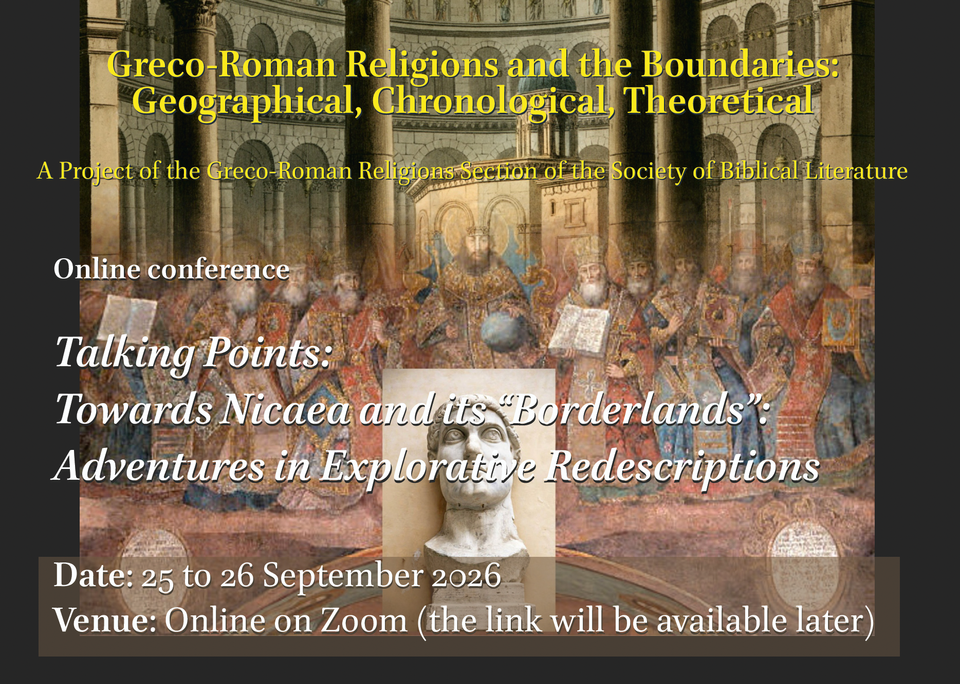
Hello SAMR! Long-standing SAMR member Jeffrey Brodd, alongside Gerhard van den Heever, have put together an online conference this coming September on the Council of Nicaea and its broader environs. This conference is hosted by our partners at the Greco-Roman Religions Section of the SBL, and is the first in a conference series entitled Greco-Roman Religions and the Boundaries: Geographical, Chronological, Theoretical.
The full PDF of the call for papers will be attached below, as well as the full conference description and CFP instructions.
Description:
The Council of Nicaea, the eponymous Creed emerging from it, and the broader Nicene/Arian controversy that led to the convening of the Council (and continued afterwards) are conventionally understood in studies on the formation history of Christianity, and theological studies generally, as perhaps the most important early stage in the establishment of what is recognised as mainstream Christian orthodoxy: “Nicaea” stands for a first "completion," the first waystation of the formation of Christianity into a worldwide religion with a defined identity (even if the Council was spectacularly unsuccessful in settling the Arian controversy, which endured for far longer, and its Creed remained unstable until formalised at later councils). And so the year 2025 saw widespread celebrations of the 1700th anniversary of the Council and its theological significance. The very numerous recent publications in the fields of systematic and historical theology, church history, early Christian historiography, and the collections of primary sources related to the Council and the Arian controversy in published critical editions, make “Nicaea” one of the most densely documented events of early Christian history and theology, and of Late Antiquity in general.
However, to view “Nicaea” as this kind of symbol – as theology – is to disembed it from the material conditions in which it came into being and which shaped it. While it is, of course, taken for granted that one of the most determinative features of “Nicaea” was the initiative and the role played by Emperor Constantine I in convening the Council and intervening in the formulation of doctrine, it remains a desideratum to reflect on how “Nicaea” was embedded in and manifested imperial and dynastic politics – and the religious ideologies and symbolisms carried with it – from the Tetrarchy till way beyond the Council and controversy into the sixth century.
Furthermore, “Nicaea” also stands at the junction of various other contextual discourses and practices: it manifests Late Roman philosophical theology spanning the arc from Middle- to Neoplatonism; it “floats” on the sea of popular religion and incipient martyr- and saints' cults and later, Marian cultic veneration; and it interconnects with a whole range of popular traditions continuing to exert their pull.
The purpose of this conference is not to rehearse the known history of the Council and the Nicene controversies – that is already well-known, but to envision and, through explanatory theorising, explore the productive intersections of all the above-mentioned trajectories, to propose a view of “Nicaea” not as a decontextualised, in-itself-standing “thing,” with its meaning residing in the domain of theological discourses associated with and clustering around the Council and its Creed, but as a discursive formation, and hence, highlighting the phenomenon of “Nicaea” as a series of speech acts and performances operationalising social formations and political practices.
Call for Papers:
Papers are invited that set out proposals for new understandings of “Nicaea” in terms of the scope as described above. Papers may also address issues in critical historiography in so far as these assist redescription of “Nicaea” as phenomenon.
Presentations will ideally be 30 to 40 min. with 20 min. questions and discussion. Presenters are encouraged to make papers available beforehand on the conference site.
Please submit proposals by Friday, 3 July 2026.
Submit proposals to:
Gerhard van den Heever, University of the Western Cape, vandenheevers@lantic.net
Jeffrey Brodd, California State University, Sacramento, jbrodd@csus.edu